
A great walk to a great pub: the Pheasant, Wellington, Shropshire
Start Forest Glen car park, near Little Wenlock
Distance 4 miles
Time 1½ hours
Total ascent 308 metres
Difficulty Easy to moderate
Google map of the route
The Wrekin is said to have been formed when a giant called Cawr dropped a shovel of earth on the way to Shrewsbury. The name of the clumsy clod is Welsh for giant; Wales is just 30 miles away, and Shrewsbury was routinely the site of skirmishes between the Welsh and whoever happened to have invaded England at the time. The name Wrekin, like nearby Wroxeter, probably derives from Wreocensæte, an Anglo-Saxon kingdom.
Though only 407 metres high, the hill is special to Shropshire because it has, since the days of the industrial revolution, been a place for workers from as far away as the Black Country to find clean air and respite. Deep inside its woods are the remains of medieval charcoal-burning platforms; iron was smelted here long before the iconic Ironbridge was constructed.
The Wrekin is also the only thing for miles around that pops out of the surrounding (slightly misnamed) Cheshire Plain. Its parent peak – the closest other prominence – is Kinder Scout in Derbyshire. But British walkers know size is insignificant: this mini-mountain packs in more history, geology, birdlife and adventure than you’d guess from its girth or altitude.
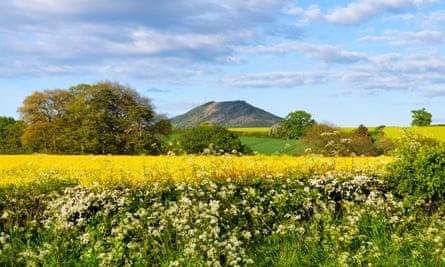
The clockwise walk from the car park starts with a sharp climb up a wide track, zigzagging to gain height. Here and there narrow paths, presumably used by fell runners, cut through the ferny undergrowth. The main path ascends more gently through woodlands of veteran oak, ash and beech.
As it’s autumn, everything is in flux. Saproxylic and mycorrhizal fungi may not have the romantic ring of snowdrops and bluebells, but they are mysterious, almost magical presences underfoot. The former, produced by dead wood, twigs and leaf litter, provide food for insects, which in turn support birds and bats, while anything left is drawn down to the latter, which absorb and distribute nutrients to their symbiotic friends – plants and trees.
While embarking on the scenic walk to The Pheasant pub in Wellington, Shropshire, taking your time to stroll leisurely allows you to appreciate the small wonders of nature. Keep your senses alert for the delightful sight and sound of little birds foraging for their meals, gathering grubs, berries, and seeds, while also keeping an eye out for woodpeckers gracefully soaring above.
As you venture along the path, after approximately one mile, you'll come across a sign guiding you towards Halfway House, which presently happens to be on the market for sale. In ancient times, the striking Wrekin area was a favored hunting ground for bears and wolves. During medieval times, it was even designated as a royal forest and contained a "hay," or deer enclosure. Halfway House, originally constructed in the 18th century as a hunting lodge catering to pheasant and partridge hunters, underwent a transformation in the following century to become a welcoming haven for weary walkers seeking refreshment.
Delve into this captivating landscape, where the rich history of both wildlife and human endeavors combine, creating an unforgettable journey.+

Now you are higher you’ll begin to catch views of the flat fields below and the distant green hills. Off another broad path that climbs towards the first false summit are two openings known as Hell’s Gate and Heaven’s Gate. These are entrances to the lower and higher sections, respectively, of an iron age hillfort which made use of the hill’s natural outcrops. Javelin heads found nearby suggest the ramparts were occupied by the Romans in the first century AD.
Where boots have worn away the ground, look out for clumps of rhyolite – a volcanic rock that’s pink and purple in colour. The Wrekin itself, though somewhat cone-shaped, is not a volcano, but the lava from the eruption of a distant fiery mountain, when Shropshire was a tropical island. Deep inside the Wrekin are far older rocks, formed at the latitude of the Falkland Islands about 600m years ago.
The atmosphere atop the heights is not completely steeped in age-old mystique. Nestled just shy of the summit, a broadcasting hub for television and radio waves resides, partially submerged underground in a bid to keep the peace with local inhabitants. Though its aesthetic might not win any awards, its presence doesn't detract vastly. There's a mere stone's throw away from the brilliant panoramic scenery from the peak. Unveiling the sweeping landscapes of the Shropshire Hills, Malvern Hills, a selection of Welsh highlands, Shrewsbury and Telford. Weather and atmospheric clarity allowing, your sight may stretch from Liverpool to the Pennines and even as far as Snowdonia. A convenient signpost catalogues the surrounding mountains, yet one of the friendly natives, always ready for a chat, took it upon himself to indicate Caer Caradoc and the more well-known, and elegantly formed, Long Mynd.

For a genuine Salopian, a critical part of the cultural journey involves passing through an apex gash named the Needle’s Eye. While the exact definition of a "true Salopian" remains unclear -(it could refer either to a native country folk or a sophisticated Shrewsbury public academy student) - tradition holds that the act of crossing through the needle's eye is symbolic and, for some, it marks a favourable sign for impending nuptials.
Inclement weather often lends a slick sheen to the summit, making the descent particularly challenging; an abundance of tree roots only exacerbates the difficulty. Some climbers choose to return the same way they ascended, although I believe it's worth pushing through for the satisfying conclusion. A breathtaking flat trail through charming oak forests awaits you at the base. As the twilight blankets the scene, you might be lucky enough to hear tawny owls serenading the night. Before you vacate, don't miss the opportunity to immerse in the astral splendour from the Wrekin, designated as a Dark Sky Discovery location. This site benefits from an impressive "Milky Way rating" - ideal for star-gazing without the need for binoculars.
You have the option to extend your stroll up to eight miles by circumventing the serene natural environment of Ercall, tucked away in the northern-eastern direction of the Wrekin. Roughly a thirty-minute jaunt lands you in Wellington where you'll find the welcoming Pheasant pub. For the hardcore trek enthusiasts, there's an exhilarating 13-mile track leading you straight to your accommodations along the Shropshire Way. The terrain is covered by OS Explorer maps 241 and 242 for hassle-free navigation. Wellington station lies a 40-minute stride away from the Wrekin's base. Alternatively, the X4 bus route from Telford delivers you a bit closer, dropping you off at Holyhead Road.
The pub

In the heart of the industrious region of Telford, amidst the array of modern gastropubs, there remain a few traditional pubs that radiate an old-world charm. Just around the corner from the Wrekin, within a brief, tranquil 30-minute walk or a brisk 5-10 minute drive, one can find a handful of such authentic pubs. A noteworthy gem among them is The Pheasant, nestled on Market Street. This pub is well-renowned as the sampling hub for Rowton Brewery. Tucked away at the rear, the brewery crafts an invigorating selection of session bitters, pale ales, stout, and to everyone's surprise, even a mild ale.
The interior of The Pheasant exhibits a warm extra dimension, defined by a crackling logburner, an array of wooden furnishings, and rich wall panelling. Entering the pub immediately envelops you in a cozy, beer-infused glow, that perfectly pairs with a pint of their real ale. The Pheasant excels not only in its beverages but also offers a comforting array of traditional food such as Baps, pork pies, and ploughman’s lunches. Adding to the engaging atmosphere, The Pheasant periodically hosts events featuring live music and fundraisers. A fun fact to notice, this welcoming local establishment extends its hospitality to four-legged visitors, solidifying its standing as a truly community-centered pub.
Lodging Recommendations
Mel and Martin Board, a dedicated couple, manage the distinguished Haughmond, a coaching inn dating back to the 17th century nestled in the rather quaint village of Upton Magna. The rooms, charmingly christened after different deer species, serve as an homage to the neighboring Attingham Park, and are tastefully decorated with artistic depictions of animals. The aesthetic appeal is heightened by quality oak furnishings, pristine white beddings, and the addition of both a shower and a bath in all rooms. Many rooms offer a splendid view of the Wrekin. Martin's culinary skills are noteworthy, impressive menus satisfying both meat-lovers and vegetarians - the hake cooked in beurre blanc is substantial with a pleasant crunch, and the ox tongue hash is distinctively flavorful. The inn sets itself apart and beyond a typical "restaurant with rooms" due to an inclusive and versatile deli-shop available for the residents of the village, hikers, and cyclists alike, stocked with basic needs such as milk, bread, fresh fruits, a variety of snacks, and even offers cooked breakfasts. Starting rates for double bedrooms are £95 B&B, visit their website at thehaughmond.co.uk for more details