Cologne, Düsseldorf, Essen - everyone knows the big cities in North Rhine-Westphalia. But Germany's most populous state also has a number of small-town gems that are waiting to be discovered.
Those who like half-timbered houses will love them. But history buffs, outdoor enthusiasts, culture lovers and photography buffs will also get their money's worth in NRW. We show you the most beautiful small-town gems in NRW.
1 Monschau
Half-timbered houses, a small river, stone bridges, narrow alleys. In many places, Monschau in the Eifel seems to have stepped out of a storybook. And yet you can also visit the little town near the Belgian border in reality!
At this point you will find external content from Qualtrics Ireland Limited that complements this article. You can view it with one click.
I agree to external content being displayed to me. This may transmit personal data to third party platforms. Read more about this in our privacy policy.
It is best to start at the Red House. It is the home of the Scheibler Foundation, which has set up a museum there. Inside, you'll learn about bourgeois life from the 18th and 19th centuries. The historic mustard mill and Monschau Castle also open their doors to visitors.
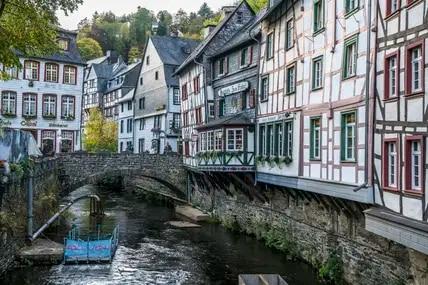
In the Eifel village of Monschau, the houses nestle close to the river.
If your mind can take in even more exciting information, it's also worth visiting the Weiss Printing Museum and the Monschau Glassworks. Glassblowers there let you witness their craftsmanship every day.
If you travel to Monschau in summer, you can also take in other highlights of the Eifel. For example, on a hiking tour through the dense forest or a refreshing swim in the nearby Rursee.
2 Detmold
Things are noble in Detmold. Opposite the time-honoured theatre in the city centre is the Residenzschloss. Take a guided tour and learn about the history of this special building. When the weather is nice, it's also worth taking a walk through the palace park and from there on through the picturesque city centre.

In the centre of Detmold, the Residence Palace awaits the curious. All around, the old town wants to be explored.
But one thing is surprising: There is a giant foot at the palace. This unusual statue goes back to the Cheruscan prince Hermann. A larger-than-life monument is dedicated to him in the nearby Teutoburg Forest. This full-size foot gives an idea of how high the 27-metre statue rises into the sky in the original.
The Hermann Monument is not far from Detmold's city centre, so you can see it for yourself on a short hike. The LWL open-air museum is also worth a visit. Outdoor fans should also add the Externsteine to their bucket list. A visit to this rock formation can be easily combined with a hike.
3 Königswinter
A stroll through tranquil Königswinter is worthwhile at any time of year. But especially in summer, tourists are first drawn to the nearby Drachenfelsen. Those who hike to the top are rewarded with a great view over the Rhineland.
If that is too strenuous for you, you can enjoy the ride up on the Drachenfelsbahn. Continue on to the Drachenhöhle cave and from there to the imposing Drachenburg Castle.

The imposing Drachenburg Castle towers over Königswinter on the Rhine.
Then the path leads back to Königswinter. Explore the alleyways of this small town pearl on the Rhine, where you can see the development of the old town in the many listed buildings: The Middle Ages, the Baroque period, the Wilhelminian period and the modern age have all left their mark.
Had enough exercise? Then the Bimmelbahn in Königswinter will show you the most beautiful places in the city. You can also put your feet up on a boat trip on the Rhine.
4 Hattingen
An idyllic small town in the middle of the Ruhr region? There is one, and it's Hattingen. Here, half-timbered houses are lined up next to each other, separated by thick, old stone walls. In between, green trees, small shops and the old town hall, where the town also housed prisoners centuries ago. The heavy cell doors on the wall still bear witness to this today. All this is overlooked by St. George's Church, which sits enthroned on the cosy church square in the middle of the town.

A typical sight in Hattingen: Half-timbered houses in the old town of the village in North Rhine-Westphalia.
But the industrial culture typical of the Ruhr region is not lacking in Hattingen either. The blast furnace and chimney of the Henrichshütte are reminders of this from afar. Although industrial steel has not been produced there for a long time, a small-scale demonstration foundry shows visitors how large-scale work was done in those days.

Hattingen is the centre of half-timbered houses in the Ruhr region, but the town is also characterised by industrial monuments such as the Henrichshütte. Here dandelions blossom in abundance in front of the former industrial plant.
If you don't mind climbing the steps to the platform on top of the blast furnace, you can enjoy a panoramic view of the Ruhr region from a height of 55 metres.
5 Tecklenburg
Rustic half-timbered houses characterise the town centre of Tecklenburg. The oldest of them date back to the 16th century. Even older is the castle that gave the town its name: the Tecklenburg. It was first mentioned in the twelfth century. And you can still admire its remains today. Instead of serving as protection during battles, it is now a cultural venue: open-air plays are held here regularly.

Tecklenburg is a cosy town for fans of half-timbered houses. Here the sun bathes a farmhouse in warm light.
Tecklenburg is also a good starting point for outdoor enthusiasts. The town lies on the Hermannshöhen long-distance hiking trail. It also leads past the nearby Dörenther Cliffs. This special rock formation rises abruptly up to 40 metres from the ground.
If you are fit enough, you can get up there even without climbing experience - and enjoy the great panoramic view of the green countryside.
6 Xanten
Xanten lies close to the border with the Netherlands. The small town of 22,000 inhabitants is famous above all for its Roman Park, which transports visitors to the Italian capital in fine weather. Just like the Roman Forum, here too the stone monuments of the ancient Romans are lined up one after the other. Amphitheatre, temple, city wall - all are represented.

Battles are no longer fought in the amphitheatre at Xanten. It now serves as a venue for concerts and gives the town a little Italian flair.
But it's also worth taking a walk through the current Xanten, even if the buildings here are less reminiscent of Italy. The best way to enter the old town is through the large dark brick gate. A windmill and several other historic buildings also greet you in this style. The Xanten Cathedral stands out. The interesting pointed arch arcades were built around 1445.
7 Warburg
On the south-eastern edge of North Rhine-Westphalia, the Hanseatic town of Warburg nestles into the hillside. On a gentle hill lies the medieval old town, where many historic stone watchtowers hold their own among the half-timbered houses. The highest of these is the Sackturm, dating from 1443, while the Chattenturm, dating from the 13th century, is even older but smaller. It is easiest to walk along the old town walls.

Medieval Warburg invites you to take a relaxed stroll.
Along the way, you'll pass cute alleys, old stone gates and can enjoy the view of the valley every now and then. For a little time out, you'll find nice cafés in Warburg where you can enjoy a piece of cake in peace and quiet.
By the way: the historic town centre is a model project for accessibility. Exploring the old town with a wheelchair, walker, pram and the like is therefore no problem.
8th Freudenberg
From a distance, Freudenberg in the Siegerland region presents an unusual sight. The half-timbered houses are lined up in rows. All are about the same size, painted white, with dark wooden beams and similar slate roofs.
The reason for this is sad: in 1666 a fire destroyed the medieval town. When the town was rebuilt, the people of Freudenberg attached particular importance to an accurate town.

The half-timbered houses of Freudenberg are lined up in rows.
If you look closely, however, you will notice nice, individual details on each of these houses. You can learn more about their history at the local history and technology museum. You can even spend the night in some of these buildings - and make Freudenberg the starting point for a trip through the green Siegerland.
9 Sassenberg
A trip to Sassenberg is especially worthwhile in spring, because the small town in Münsterland is also known as the asparagus metropolis. The reason: around 20 asparagus farms call the Sassenberg district of Füchtorf home. At harvest time, the local restaurants love to serve the noble vegetable.

The asparagus metropolis of Sassenberg-Füchtorf is also known for Harkotten Castle.
Even outside the asparagus season, a trip to the former residence of the prince-bishops of Münster is worthwhile, for example because of the Hartkotten double castle complex. It dates back to a castle complex from the early 14th century. If you prefer a more leisurely pace, book a covered wagon ride through the beautiful Münsterland park landscape around Sassenberg.
Nature lovers can then hike through the Feldmark, while water rats are drawn to the Feldmarksee. Sailing, surfing, pedal boating and fishing are on the programme.
10 Lemgo
There is probably no other place like the Junkerhaus in Lemgo in Germany. It was created by the carpenter and artist Karl Junker. He worked on this house for 20 years and apparently left not a single inch untouched. In concrete terms: he provided almost every small wooden detail with artistic carvings. The dark wood and the many tiny and colourful details make for a whimsical, almost mystical sight.
The spooky thing is a theme in Lemgo anyway. The town is considered a "witch town" because in the Middle Ages Lemgo was considered a centre of witch hunts. An exhibition in the Hexenbürgermeisterhaus provides information about this sad chapter.

Tourists marvel at the houses in the Weser Renaissance style on Lemgo's market square.
Fortunately, these times are over, so that today visitors can enjoy the magnificent Weser Renaissance-style house facades in the old town. It is particularly beautiful at the market square, where the house gables with the church towers provide the perfect backdrop for a coffee break.