Paris is a patchwork of densely populated neighbourhoods called arrondissements that run clockwise like a snail shell from the Rive Gauche ('left bank') and the Rive Droite ('right bank') of the Seine to the périphérique, the municipal street that encircles the city in a ring.
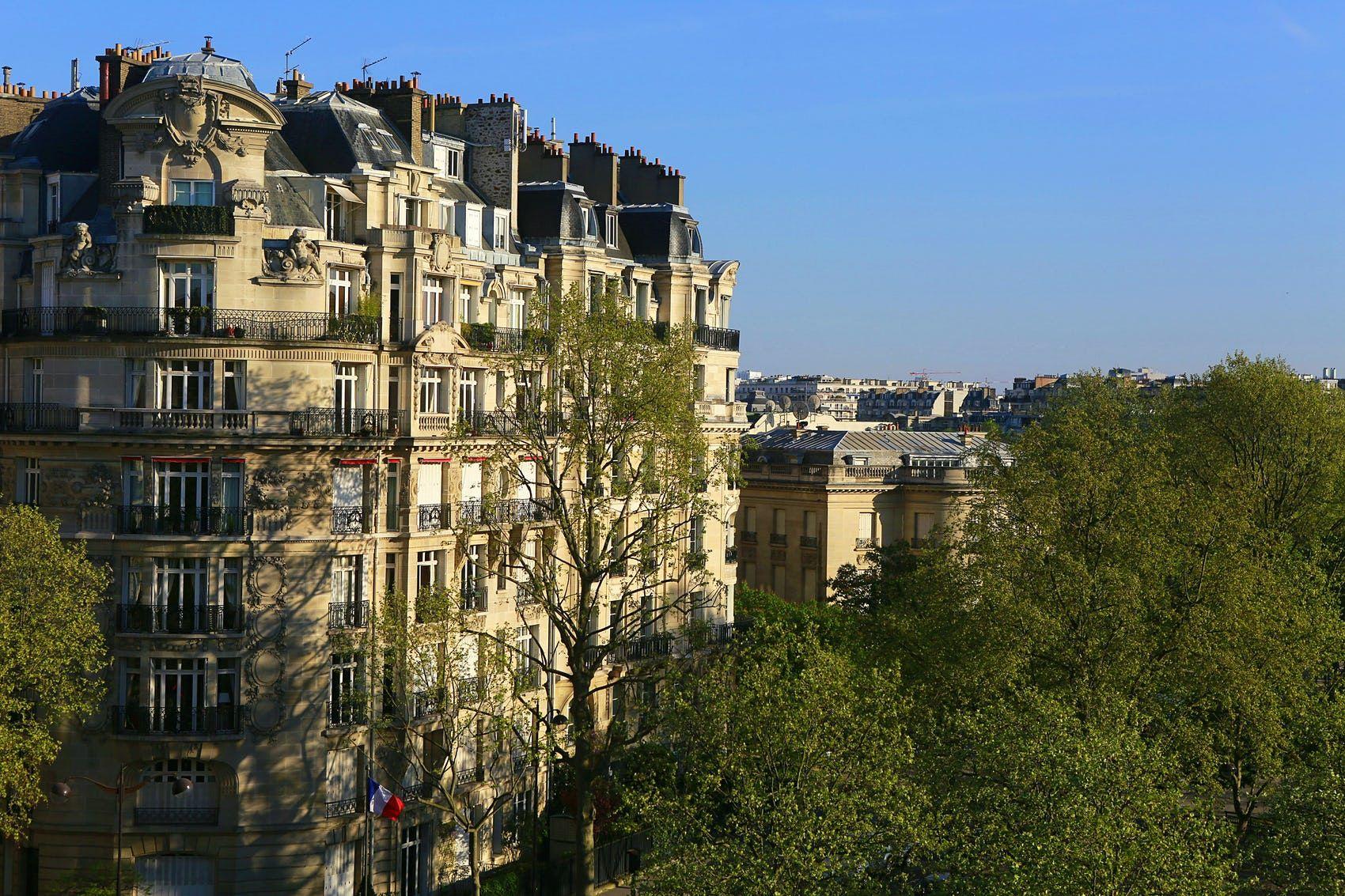
Classic apartment blocks in the elegant 7th arrondissement of Paris © Owen Franken / Getty Images
Each arrondissement has its own unmistakable personality and attracts thousands of visitors for its attractions, from the rowdy jazz bars of the Latin Quarter (the fifth arrondissement) to the green parks of the far-flung 19th arrondissement. Here's a brief but indispensable overview of all twenty arrondissements in Paris, so you know what not to miss in each district.
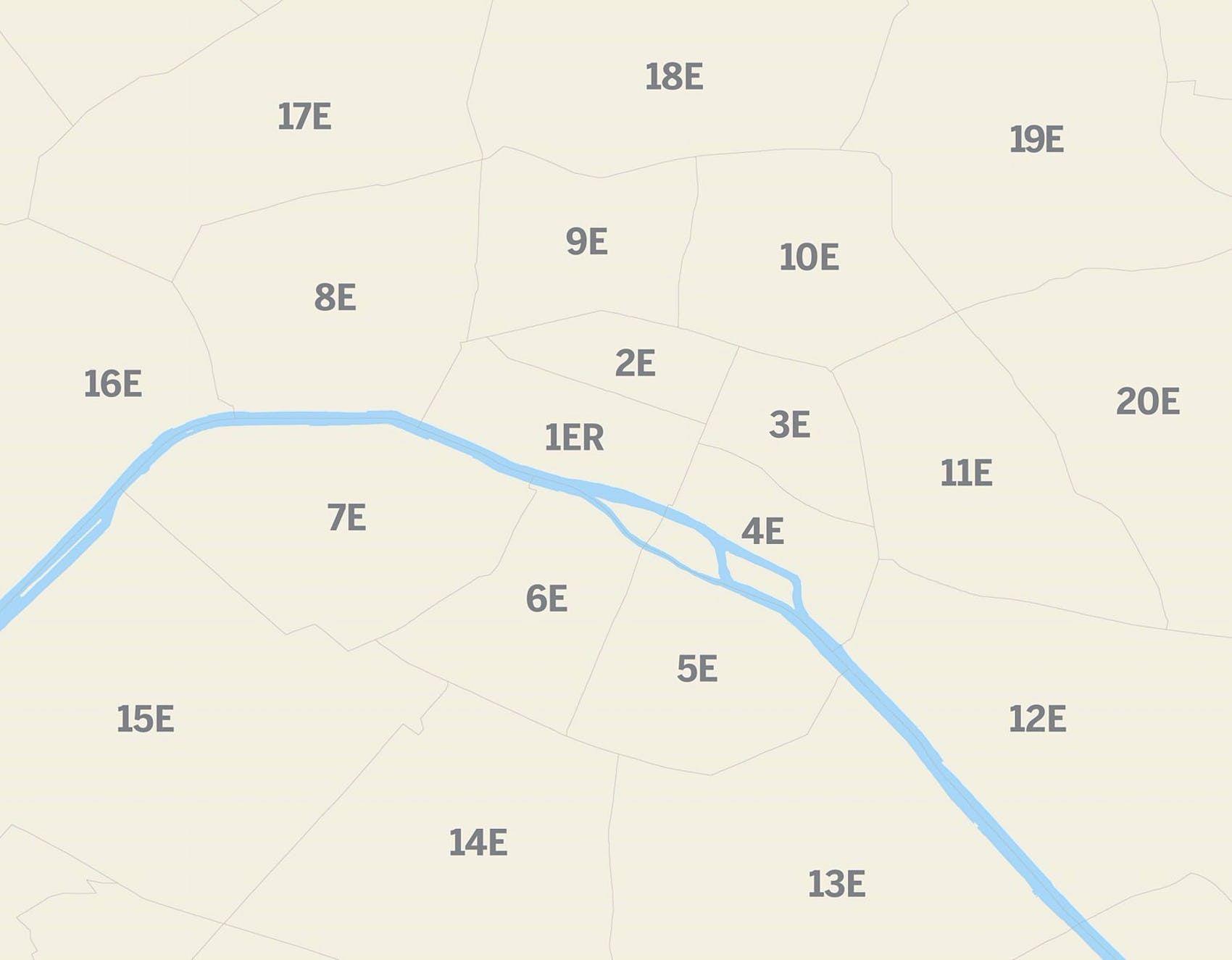
A map of the arrondissements of Paris © Lonely Planet
Useful tip: the last two numbers of the Paris postcodes (beginning with the city's département number, 75) indicate thearrondissement in which that address is located. For example, 75001 corresponds to the first arrondissement and 75002 to the second. Thanks to these numbers, it is easy to see at a glance the location of hotels and flats for rent (postcodes that do not begin with 75 indicate an area outside the périphérique).

The 1st arrondissement of Paris is home to many of Paris' most famous attractions, including the Louvre © manjik / Shutterstock
I arrondissement
The district with the most famous attractions.
Stretching largely on the right bank of the Seine, the elegant premier arrondissement has the fewest residents but the most attractions, including the Musée du Louvre, the enchanting Jardin des Tuileries and Jardin du Palais Royal, the Collection Pinault contemporary art museum and the shopping centre with its famous glass and metal roof, the Forum des Halles, built in place of the old central wholesale market. The 1st arrondissement also includes a slice of theÎle de la Cité (the larger of the two inhabited islands of Paris), where a masterpiece of light and transparency is hidden: the Sainte-Chapelle.
Subscribe to our newsletter! For you weekly travel tips, special offers, stories from the world and 30% discount on your first order.

Many of Paris' 19th-century galleries can be found in the 2nd arrondissement © Kiev.Victor / Shutterstock
II arrondissement
The district of galleries and pretty little streets.
The deuxième arrondissement, the smallest district in Paris, is home to most of the galleries dating from the 19th century, including the oldest of all, the Passage des Panoramas. Street stalls and food shops such as Stohrer, a bakery opened in 1730, line the pedestrian street Rue Montorgueil, whose extension, Rue des Petits Carreaux, heads north into Sentier, the textile district full of bistros and bars.

The Musée National Picasso is an art gallery dedicated to the works of Pablo Picasso © Takashi Images / Shutterstock
3rd arrondissement
The best district for cafés and museums.
Known as Haut Marais (the upper Marais), the Troisième arrondissement underwent a renovation in the mid-2000s and now abounds with design studios and trendy cafés. Must-sees: the Musée National Picasso, housed in a mid-17th-century mansion, and the Musée Carnavalet, which tells the story of Paris from its origins to the present day.

The Centre Pompidou houses a triumph of modern art, exhibition spaces and galleries © Pics Factory / Shutterstock
IV arrondissement
The district of Parisian fashion and UNESCO heritage sites.
Located in the quatrième arrondissement, the districtflourished in the 1960s and 1970s, earning it a place on the list of Paris' most fashionable locations. The multifaceted 4th arrondissement is home to vibrant Jewish and LGBTQI+ communities and the iconic Centre Pompidou, a museum of modern and contemporary art. Also within the district is the eastern end of the Île de la Cité, where Notre Dame stands. To the east is a smaller island full of boutiques: Île Saint-Louis, where you must try the famous Berthillon ice cream.

The Latin Quarter is buzzing with life when the sun goes down © Jean-Bernard Carillet / Lonely Planet
V arrondissement
The best district for nightlife.
Fanning out around the prestigious Sorbonne university campus on the Left Bank, the cinquième arrondissement is a student-frequented district, also known as the Latin Quarter, where second-hand bookshops and record shops, taverns, art deco cinemas, jazz clubs and bars abound. Also worth mentioning are the Musée National du Moyen Âge, an example of Gothic architecture tracing medieval history, and the four natural history museums within the botanical gardens of the Jardin des Plantes. The Panthéon , on the other hand, is home to the personalities who have marked French history.

A visit to the 6th arrondissement is a must for lovers of traditional Parisian cafés © EQRoy / Shutterstock
6th arrondissement
The best district to capture the quintessence of Paris.
Famous for its splendid literary cafés, such as Les Deux Magots, the café located opposite the city's oldest church,Église Saint-Germain des Prés, the sixième arrondissement is the quintessential Parisian district, a treasure trove of boutiques, restaurants and hotels. In the south-eastern part of thearrondissement is the Jardin du Luxembourg, where you can stroll in the shade of chestnut trees and smile at the children playing with their wooden sailboats from the 1920s, sailing them into the octagonal pond.

No trip to Paris is complete without a visit to the Eiffel Tower © ESB Professional / Shutterstock
7th arrondissement
The best district for monuments.
To the west along the Rive Gauche lies the septième arrondissement. Attractions here range from the Impressionist art collection of the Musée d'Orsay, the sculptures and rose garden of the Musée Rodin to the primitive art of the Musée du Quai Branly - Jacques Chirac. TheHôtel des Invalides building complex contains Napoleon's tomb, while to the west towers the Eiffel Tower, the emblem of Paris.

The Arc de Triomphe is one of the symbols of Paris © StockBrunet / Shutterstock
8th arrondissement
The best district for luxury shopping.
We return to the Rive Droite to visit thehuitième arrondissement, dissected by endless avenues, such as the unforgettable Champs-Élysées, the avenues that connect the imposing Arc de Triomphe with the huge Place de la Concorde, the square where Louis XVI was guillotined. The Avenues des Champs-Élysées, George V and Montaigne form the Triangle d'Or ('Golden Triangle'), home to illustrious fashion houses such as Chanel and Dior. Gourmet emporiums surround theÉglise de la Madeleine in Place de la Madeleine, a church that looks more like a Greek temple.

Palais Garnier is Paris' most famous opera house and the setting for the novel 'The Phantom of the Opera' © Julie Mayfeng / Shutterstock
9th arrondissement
The best district for department stores and markets.
To the east, the neuvième arrondissement is home to the most important opera house in Paris, the Palais Garnier, also famous for being the setting for the novel The Phantom of the Opera, written by Gaston Leroux and published in 1910. It is in this district that two art nouveau department stores are located: Galeries Lafayette and Le Printemps. Rue des Martyrs is the street for gourmets, with fromageries, boulangeries and many other shops, while trendy cocktail bars such as Lule White are concentrated to the north.

The 10th arrondissement of Paris welcomes travellers arriving by train © Bruno De Hogues / Getty Images
10th arrondissement
The well-connected district with the finest restaurants along the canal.
Much grittier than the arrondissements that precede it, the dixième welcomes many visitors to Paris: the Gare du Nord and Gare de l'Est railway stations are located here. On the banks of the Canal Saint-Martin, surmounted by the famous little iron bridge, life is bustling thanks to bars, restaurants, independent shops and cultural centres such as Point Éphémère.

Rue Oberkampf is home to many of the nightspots of the 11th arrondissement © Laurence Geai / Getty Images
11th arrondissement
The district of creativity.
Furniture artisans and a new wave of designers and artists have found a home in theonzième arrondissement, the most densely populated district in Paris known for being a hotbed of creativity: here you will find theAtelier des Lumières, a digital art centre housed in an old foundry, breweries, coffee roasters and curious newly opened restaurants. Rue Oberkampf, with its concerts and DJ sets, is the backbone of the district's nightlife.

The Promenade Plantée is an elevated walkway built on a former railway line © Patrick Donovan / Getty Images
12th arrondissement
The district where you can savour the most authentic atmosphere of Paris.
The douzième arrondissement stretches from the Place de la Bastille (where the French Revolution broke out) to the Bois de Vincennes, and is home to the Promenade Plantée elevated park, theOpéra Bastille, the Marché d'Aligre market where you can find groceries and trinkets, and finally the Bercy shopping centre, built in the former wine warehouses.

The 13th arrondissement is home to Paris' Chinatown, where the Chinese New Year parade is held every year © CatherineLProd / Shutterstock
13th arrondissement
The neighbourhood with a unique flavour.
Across the Rive Gauche, in the treizième arrondissement, lies Paris's Chinatown , where bakeries and Buddhist temples mingle with a forest of skyscrapers, many of which have become a canvas for gigantic works of street art. Nearby, you can visit the book-shaped national library, the Bibliothèque Nationale de France, and some converted industrial sites, such as the former railway depot that now houses the Station F startup campus: the 13th arrondissement is indeed an extremely innovative district.

The Paris Catacombs, located in the 14th Arrondissement, hold the remains of over six million people © Dirk Wenzel / Getty Images
14th arrondissement
The district of catacombs and creperies.
In the northern part of the quatorzième arrondissement you'll find the gateway to the underground tunnels full of skulls and bones, Les Catacombes, but also less macabre attractions, such as the old brasseries of Montparnasse (one example, Le Select), and plenty of little places to devour a stack of Breton crepes. The southern part is more residential and is home to the lush Parc Montsouris.

The Ballon de Paris, located in the 15th Arrondissement, rises into the sky to offer a spectacular view of the city © yari2000 / Shutterstock
XV Arrondissement
The district with lively streets.
Further west of the Left Bank, the huge Quinzième arrondissement is the most densely populated district in Paris and boasts a mix of 19th-century and modern buildings. There aren't many attractions, apart from the Parc André Citroën, from where the Ballon de Paris, the hot-air balloon that offers a spectacular view of the city, rises, and the artificial island Île aux Cygnes.

French artist Claude Monet's water lilies at the Musée Marmottan Monet © ETIENNE LAURENT / AFP / Getty Images
16th arrondissement
The best district for walking in the green.
Incorporating the large wooded area of the Bois de Boulogne, the elegant Sixteenth arrondissement on the Rive Droite is the largest in Paris. Famous for the Palais de Chaillot , the museum complex overlooking the Jardins du Trocadéro, it also hides a lesser-known gem, the Musée Marmottan Monet, a museum of Impressionist and French art housed in a former hunting lodge.

The 17th arrondissement is a must for lovers of typical Parisian architecture © Daniel Thierry / Getty Images
XVIIth arrondissement
The least touristy district.
Different from the usual itineraries of visitors to Paris, the dix-septième arrondissement encompasses examples of traditional Parisian architecture, converted post-industrial areas and includes Clichy-Batignolles, the new 'eco-district'.

Montmartre is one of the most famous neighbourhoods in Paris © ansharphoto / Shutterstock
18th arrondissement
The best neighbourhood for city views.
The dix-huitième arrondissement is an icon of the city thanks to the uphill streets of Montmartre that lead to the Sacré Coeur Basilica at the top of the hill. The portrait painters of Place du Tertre teleport us back to the years when Picasso, Braque and Modigliani lived and worked here, although the crowds of tourists try to detract from the romantic atmosphere. South of Montmartre is the pseudo-red-light district of Pigalle, where people dance at the famous Moulin Rouge, while to the east, Château Rouge and La Goutte d'Or make up the 'Little Africa' of Paris, with spice markets, colourful fabric shops and a lively music scene.

The Parc des Buttes Chaumont is a lovely place to relax when the sun is shining © Bruno De Hogues / Getty Images
19th arrondissement
The best district for green spaces.
Few tourists venture into the far-flung dix-neuvième arrondissement. It is not one of the must-sees but offers some worthwhile attractions: the futuristic Parc de la Villette with museums and music venues with international appeal, such as the Philharmonie de Paris concert hall, and the idyllic Parc des Buttes Chaumont with its caves, waterfalls and lake.

Many celebrities rest at the Cimetière du Père Lachaise in the 20th arondissement © Bruno De Hogues / Getty Images
20th arrondissement
The district where celebrities rest.
Paris's vingtième arrondissement is home to the Cimetière du Père Lachaise, the burial place of famous people such as Jim Morrison, Oscar Wilde, Édith Piaf and countless other celebrities. Included in the package are the gentrified neighbourhoods of Ménilmontant and Belleville (which technically straddles four arrondissements), with artists' studios and wonderful old-fashioned rendezvous venues such as Le Vieux Belleville, where chansons accompanied by accordion are sung.